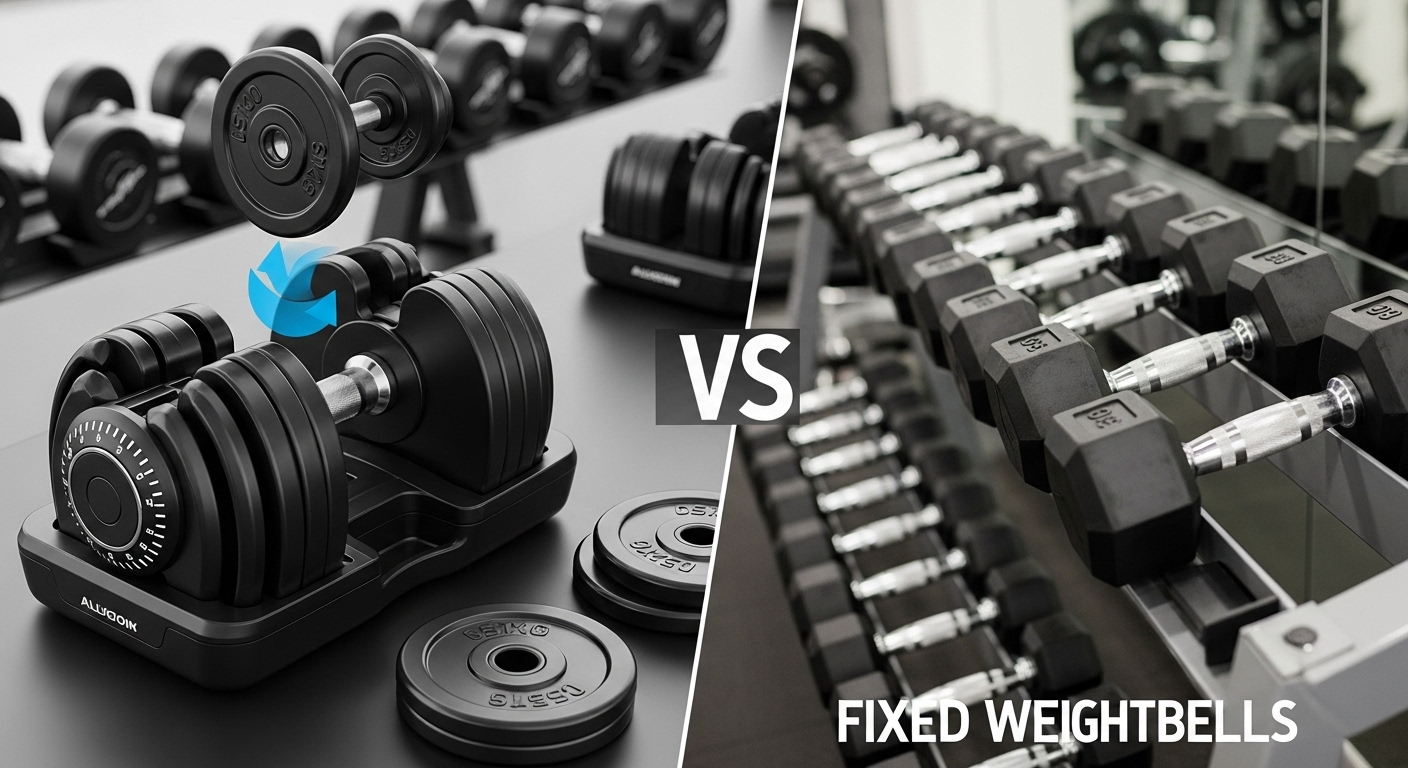
If you’re building a home gym (or just trying to train consistently), dumbbells are usually the first “real” purchase. The big question is whether to go adjustable (one pair that changes weight) or fixed (separate pairs at each weight). Both work—your best choice depends on how you train, how much space you have, and how much you hate switching weights mid-workout.
Disclosure: Some links may be affiliate links. As an Amazon Associate I earn from qualifying purchases.
Quick answer
- Best for small spaces + budget-efficient starting out: Adjustable dumbbells
- Best for speed, durability, and serious training flow: Fixed dumbbells
- Best “optimal” setup for most people: Start with adjustable, then add one fixed pair at your most-used weights later.
What each type is (simple definitions)
Adjustable dumbbells
One handle/set that changes weight via:
- Dial/selector systems (fast changes, usually with a cradle)
- Plate-and-collar systems (slower, often more durable but less convenient)
Fixed dumbbells
Individual dumbbells at each weight:
- Rubber hex (home-gym favorite, doesn’t roll)
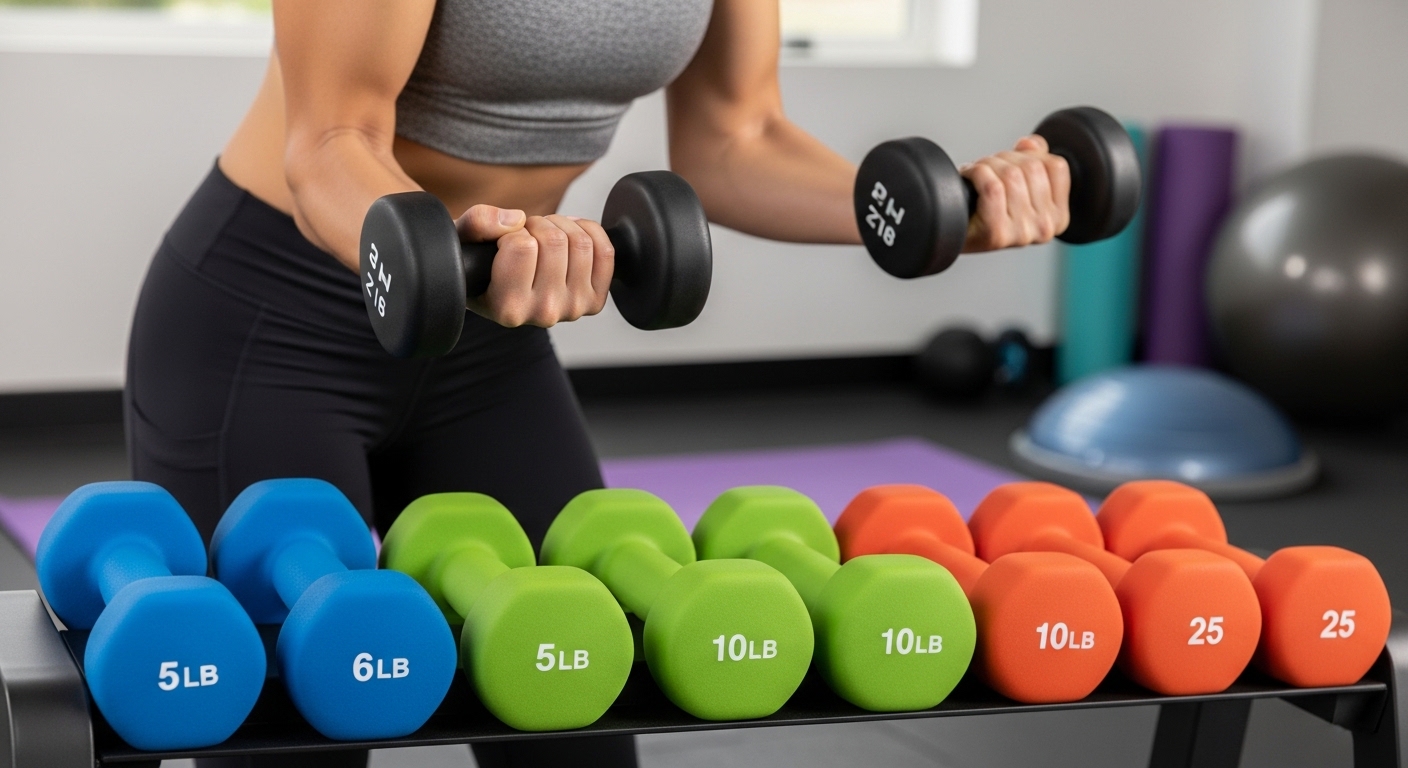
- Neoprene/vinyl (lighter weights, comfortable, beginner-friendly)
Head-to-head comparison
1) Cost (what you pay over time)
Adjustable dumbbells: usually cheaper upfront for a wide weight range.
You’re buying one system that replaces multiple pairs.
Fixed dumbbells: can be cheaper per pair—but expensive as you build a full set.
If you only need one or two pairs (light + moderate), fixed can be very cost-effective. But if you want a whole rack, costs stack fast.
Cost verdict:
- Want many weights without buying many pairs → Adjustable wins
- Only need 1–2 weights for now → Fixed can win
2) Durability (what survives years of use)
Fixed dumbbells generally win on durability.
Fewer moving parts = fewer things to break. Rubber hex pairs can take a beating and keep going.
Adjustable dumbbells vary a lot.
- Selector/dial systems: fast, but more sensitive to drops and rough handling
- Plate-and-collar adjustables: often very durable, but slower and more annoying
Durability verdict:
- If you train hard and aren’t gentle → Fixed wins
- If you’re careful, use mats, and don’t drop weights → Adjustable is fine
3) Speed (how fast your workouts feel)
This is where the difference is huge.
Fixed dumbbells are instant.
Grab the next pair and keep moving. Perfect for:
- supersets
- drop sets
- circuits
- partner workouts
Adjustables can slow your pace, depending on type:
- dial/selector: relatively fast
- plate-and-collar: slowest (especially when sweaty)
Speed verdict:
- If your workouts rely on quick transitions → Fixed wins
- If you mostly do straight sets with longer rest → Adjustable works great
4) Space (apartment reality)
Adjustables are the clear winner for small spaces.
One pair + cradle replaces a whole rack.
Fixed dumbbells take space quickly and can clutter a room unless you buy a rack.
Space verdict: Adjustable wins (by a lot)
5) Feel and range of motion (how they lift)
Fixed dumbbells usually feel more natural.
They’re often shorter and better balanced, which helps with:
- dumbbell bench press
- rows
- overhead press
- curls
Adjustables can be bulkier, especially at lighter weights, which can feel awkward in some movements.
Feel verdict:
- If you care about “gym-like” feel → Fixed wins
- If you care about variety and practicality → Adjustable wins
6) Noise + floor friendliness
Fixed rubber dumbbells are usually quieter and safer on floors than metal plate systems.
Selector adjustables can be quiet too—just don’t drop them.
Noise verdict: depends on materials, but rubber fixed pairs are the safest bet for apartment living.
Which one fits your routine? (real-world scenarios)
Choose adjustable dumbbells if you…
- Train in a small apartment or shared space
- Want many weight options without buying 10 pairs
- Do mostly straight sets (less frantic switching)
- Prefer an organized setup that stores easily
- Want to progress gradually over time
Best routines for adjustables
- full-body 3x/week
- hypertrophy with controlled tempo
- beginner strength plans with consistent exercise selection
Choose fixed dumbbells if you…
- Do supersets, circuits, or drop sets
- Lift heavy and want equipment that can take abuse
- Train with a partner (two people switching weights constantly)
- Care about the best feel and fastest workflow
- Plan to build a full home gym long-term
Best routines for fixed
- bodybuilding-style training
- HIIT strength circuits
- advanced programs with frequent weight jumps
The “optimal” choice for most people (best value + best training flow)
If you’re building a home setup from scratch, here’s the most practical path:
Step 1: Start with adjustable dumbbells
They give you the widest range with the least space and the lowest “commitment risk.” You can test what weights you actually use.
Step 2: Add one fixed pair later at your “workhorse weight”
Once you learn your routine, add a fixed pair you use constantly (often for presses/rows). That gives you:
- fast transitions for key lifts
- less wear on your adjustable system
- a smoother workout flow
Final verdict:
✅ Most people should start with adjustable dumbbells, then upgrade with a fixed pair later if they stick with training.
FAQ
Are adjustable dumbbells safe?
Yes—if you use the cradle properly, confirm the lock, and avoid dropping them. Always lift over a mat and set down gently.
Will I outgrow fixed dumbbells?
Only if you buy too light. Fixed pairs are great forever—most people just keep adding heavier pairs over time.
Which is better for beginners?
Adjustables are usually best for beginners because they allow safe progression without buying multiple sets. Neoprene fixed pairs are also great if you just want light weights for consistency.
Final recommendation
- Small apartment + want flexibility: Adjustable dumbbells
- Fast workouts + long-term durability: Fixed dumbbells
- Best overall plan: Adjustable first, then add one fixed pair later for your most-used weight.