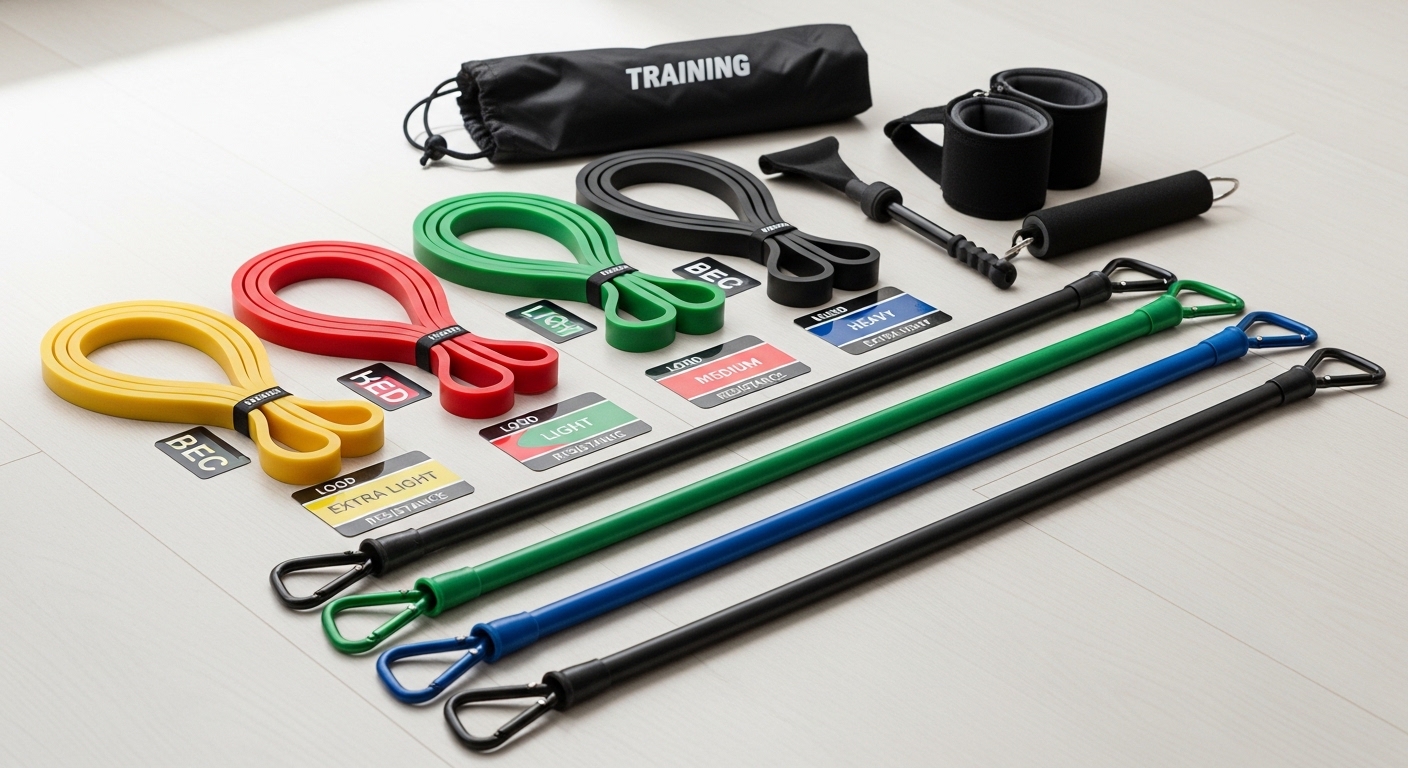
Resistance bands look “easy,” but the difference between a great band workout and a frustrating one usually comes down to setup and control. When your anchor is solid and your form is dialed in, bands feel smooth, joint-friendly, and surprisingly challenging. When it’s not… you get slipping anchors, weird angles, and reps that don’t hit the muscles you’re trying to train.
Why band form is different from weights (and why that’s a good thing)
Bands create variable resistance: the farther you stretch them, the harder they get. That means:
- The top of a rep can be the hardest part (great for squeezing and control)
- You don’t need heavy loads to get a strong training effect
- Bad setup gets punished fast (because tension changes with distance)
My biggest “aha” moment was realizing band training is less about “moving weight” and more about managing tension—keeping it on the muscle the whole time.
Step 1: Anchor setup that doesn’t slip (and doesn’t scare you)
A solid anchor turns bands into a home cable machine. A bad anchor turns them into a distraction.
Door anchor setup (the safe way)
1) Choose the right side of the door
- Anchor on the hinge side when possible (it’s more stable).
- Make sure the door closes away from you, so your pulling force keeps it shut.
2) Place the anchor correctly
- High anchor (top of door): pulldowns, face pulls, triceps pressdowns
- Mid anchor (chest height): rows, chest press, curls
- Low anchor (bottom of door): low rows, pull-throughs, deadlift patterns
3) Lock it in
- Close the door fully and test it with light tension.
- Give it a few gentle pulls before you start your first set.
4) Protect your band
- Make sure the band isn’t rubbing against sharp edges.
- Keep the band centered so tension is even.
My personal rule: If I wouldn’t trust it at the end of a hard set, I don’t use that anchor.
Non-door anchor options (if doors are annoying)
- A sturdy post/railing (only if it doesn’t move)
- A heavy immovable object (rarely ideal)
- Looping around something stable at ankle/waist height (watch for abrasion)
Step 2: The band “sweet spot” (distance = difficulty)
Here’s a mistake most people make: they start too close or too far from the anchor.
How to find the right starting distance
- Start your movement and check: Is there tension at the beginning?
- If the band is slack early in the rep → step farther from the anchor.
- Check the end of the rep: Can you finish with good form?
- If you’re twisting, shrugging, or losing control → step closer or use less tension.
Goal: light tension at the start, challenging tension at the end, zero “dead zone.”
Step 3: Form cues that make bands actually work
Bands reward clean reps. These cues apply to almost every band exercise.
1) “Own the first inch”
Start every rep slowly. That first inch tells you whether the tension is on the right muscle or on your joints/positioning.
2) Keep the band line stable
If the band path wobbles, your body is “searching” for leverage.
- Lock your stance
- Brace your core
- Keep elbows and shoulders tracking cleanly
3) Control the return (eccentric)
The return is where bands expose sloppy form.
- Come back slowly (2–3 seconds)
- Don’t let the band snap you into the start position
4) Finish the rep with a squeeze, not momentum
Bands get hardest near peak contraction—use that.
- Brief squeeze at the end (½–1 second)
- No bouncing
5) Breathe and brace
- Exhale through the hard part
- Keep ribs down and core lightly braced (especially for presses and rows)
The 5 mistakes that waste your reps (and how to fix them)
Mistake #1: Starting with slack tension
What it looks like: first half of the rep feels easy, then it suddenly gets hard.
Why it wastes reps: you’re missing the most valuable part—constant tension.
Fix: step farther from the anchor or shorten the band path so tension is present from rep 1.
Mistake #2: Letting the band pull you back fast
What it looks like: controlled pull, then the return flies back.
Why it wastes reps: you lose time under tension and feed your joints instead of your muscles.
Fix: slow the return to 2–3 seconds, keep your stance braced.
Mistake #3: Using the wrong anchor height
What it looks like: you “feel it” in shoulders/neck instead of the target muscle.
Why it wastes reps: angle is everything with bands.
Fix: match anchor height to the movement:
- Rows: mid height
- Pulldowns/face pulls: high
- Pull-throughs/low rows: low
Mistake #4: Shrugging and neck tension on pulls
What it looks like: shoulders creep up, traps take over.
Why it wastes reps: you turn back work into neck work.
Fix: “Shoulders down, chest proud.” Lead with elbows, not hands.
Mistake #5: Twisting your torso to finish reps
What it looks like: hips rotate or body turns to “help” the band.
Why it wastes reps: you’re borrowing leverage instead of building strength.
Fix: widen stance, brace core, reduce tension slightly, and slow down.
My go-to “band quality check” before any workout (30 seconds)
I do this every time because it prevents 90% of problems:
- Anchor test: light pull x3 — does it move?
- Band check: any cracks, sticky spots, fraying, or weak points?
- Tension check: is there tension at the start position?
- First rep check: does it hit the target muscle immediately?
If any answer is “no,” I adjust before I waste a whole set.
Example setups (so you can copy-paste the idea)
For rows (mid anchor)
- Stand tall, slight knee bend
- Pull elbows back and down
- Pause and squeeze shoulder blades lightly
- Slow return
For chest press (anchor behind you at mid height)
- Staggered stance (one foot forward)
- Keep ribs down (don’t flare)
- Press slightly inward as you extend
- Stop before shoulders roll forward
For pulldowns (high anchor)
- Kneel or sit back to keep tension consistent
- Pull elbows to your pockets
- Don’t lean back to “cheat” the rep
For glute kickbacks (low anchor)
- Brace core hard (this is where twisting happens)
- Small lean forward, hold something stable if needed
- Kick back under control—no swinging
How hard should band training feel?
A simple rule that works:
- For strength/hypertrophy: finish sets at about 1–3 reps in reserve
- If your form breaks or you lose tension, the set is over—don’t force ugly reps.
Bands can fry your muscles with higher reps, too. Don’t be afraid of 12–20 reps if tension stays honest.
Safety + maintenance (the boring part that matters)
- Don’t store bands in heat or direct sunlight
- Keep them away from rough edges and abrasive anchors
- Inspect them weekly
- Replace anything that looks cracked, dried out, or frayed
Final takeaway
Using resistance bands correctly is mostly about:
- A stable anchor
- No slack tension
- Slow, controlled reps
- Angles that match the muscle
- Avoiding the five mistakes above
Once you get those right, band workouts stop feeling “light” and start feeling clean, challenging, and joint-friendly—the kind you can do consistently without beating yourself up.